
Stainless Steel Jewelry Manufacturing: Tarnish-Free Claims
Tarnish is a chemical reaction, so the phrase tarnish-free is really a claim about which reactions a piece can undergo. Silver darkens because sulphur in air bonds with it; stainless steel holds no silver to sulfide, and the protection therefore rests on the alloy and the coating above it. The published stainless minimum is 100+ pieces per design, with sampling at 25–30 days and mass production at 3–4 weeks.
Key takeaways
- Silver tarnish is silver sulphide; a stainless alloy has no silver, so that reaction cannot start.
- 316L carries 2–3% molybdenum and is the grade published as shower-safe and swim-proof.
- 304 is published as water-resistant for daily wear and suited to cost-effective volume.
- Stainless MOQ is 100+ pieces per design, and each design counts separately.
What tarnish actually is
Silver tarnish is silver sulphide. Sulphur compounds in air, in wool, in rubber bands and in some foods meet the surface and leave a brown-black film that sits on the metal rather than inside it. The layer is thin enough to polish away, which is why a darkened spoon comes back with a cloth and a little paste.
Gold and the platinum group do not react this way at room temperature, so they are sold as tarnish resistant. Stainless sits in a third category: an alloy of iron, chromium, nickel and molybdenum, where the chromium forms a passive oxide layer that regrows after a scratch. There is no silver in the alloy, so the sulphide reaction that darkens sterling has nothing to work with.
That is the whole mechanism behind the phrase. It is accurate, and it is narrow. A tarnish-free stainless piece can still scratch, still lose colour at an edge and still collect soap residue in a recess, and none of those faults belongs to the tarnish family.
A stainless ring worn against a laptop edge, a car key and a gym bar gathers scratches. A scratch that cuts through the vacuum coat opens a bright line of base metal. That line is not tarnish, but it reads as wear, and buyers often use the two words interchangeably when they describe a returned item.
The coating is the second limit. PVD colour on stainless is a thin film, and thin films wear at corners, prongs and the inner edge of a ring where two surfaces rub. The factory inspects 100% of pieces before delivery, which catches a coating fault before packing; it does not predict how the piece will age on a wearer's hand.
A buyer writing a specification should split the question three ways: does the bulk metal react with sulphur, does the coating stay on the surface, and does the geometry concentrate abrasion anywhere. Tarnish-free answers the first and says nothing about the other two.
The grade question: 304 against 316L
The programme page at https://www.tttjewelry.com/stainless-steel-jewelry-manufacturer/ separates the two grades in exactly these terms. 304 is water-resistant for daily wear, nickel and lead safe, vacuum-plated and aimed at cost-effective volume. 316L adds 2–3% molybdenum, is described as waterproof, shower-safe and swim-proof, and is listed as medical-grade hypoallergenic.
Molybdenum is a small share of the alloy and a large share of the behaviour, because it raises resistance to chlorides. Chlorides are what a swimming pool and seawater supply in quantity. A piece built from 304 will survive a rainy commute; a piece built from 316L is the one the published wording covers for a swim.
For a wholesale range the trade-off is plain. 304 covers a fashion line worn to the office and taken off at night. 316L covers the piece that stays on through a shower and a workout. Using one grade for both use cases means either overspecifying the office line or underspecifying the swim line, and the second mistake is the one customers report.
Three checks before a purchase order
First, read the mark. Laser engraving of 316L is a published option, and a sample without a mark says nothing about the alloy. Second, ask for the plating statement and the compliance position: REACH restricts lead, cadmium and nickel, while CA Prop 65 adds a separate disclosure route for the United States. Third, run a wear trial on the actual design rather than a stock ring, because abrasion follows geometry.
A wear trial does not need a laboratory. Ten pieces, four weeks and a short log of showers, gym sessions and cleaning will show whether the coating holds at the edges. The result is a buying decision, not a certificate.
Buyers who want the development handled from concept rather than built to a supplied drawing can use the OEM/ODM jewelry manufacturer route, where the collection is developed and then held exclusive to the brand.
Claims, mechanisms and evidence
The table maps the marketing words onto the underlying mechanism and the document that supports each one. Read it from the bottom up when a retailer sends a compliance questionnaire.
| Claim | What it means | Evidence to request |
|---|---|---|
| Tarnish-free | No silver sulphide reaction in the alloy | Grade named on the drawing |
| Waterproof | Shower-safe and swim-proof on 316L | Grade mark and plating route |
| Hypoallergenic | Medical-grade 316L with nickel controlled | REACH compliance statement |
| Colour-fast | PVD film bonded to a prepared substrate | Surface preparation and inspection step |
| Compliant | Plating free of restricted substances | REACH and CA Prop 65 position |
Two rows deserve a second look. Hypoallergenic is a description of the alloy, not a test result, and it applies only while the alloy is what the drawing says. Colour-fast is a statement about adhesion, which depends on preparation more than on the colour chemistry. Neither can be confirmed from a photograph of a finished ring.
Worked example
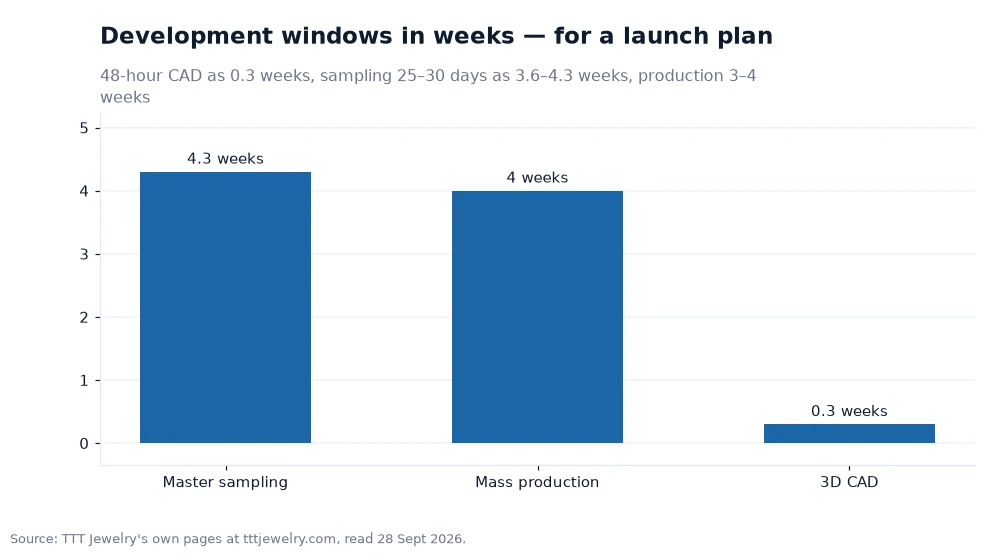
Put the calendar in weeks, because a wholesale plan usually is. CAD at under 48 hours is 0.3 weeks at two days. Master sampling at 25–30 days is 3.6–4.3 weeks. Mass production at 3–4 weeks is 3–4 weeks.
Add the slow ends: 0.3 + 4.3 + 4 = 8.6 weeks, which is 60 days. Add the fast ends: 0.3 + 3.6 + 3 = 6.9 weeks, which is 48 days. The 48–60 day range quoted in days is the same range expressed in weeks, and the conversion is worth doing because a launch calendar built on the wrong unit slips quietly.
Quantity runs beside it. One design at the 100+ stainless minimum commits at least 100 pieces. Five designs commit 500. A buyer testing two colourways of one design is opening two designs, not one, because the minimum applies per design.
Frequently asked questions
Does stainless steel jewelry tarnish?
The alloy contains no silver, so the sulphide reaction that darkens silver does not occur; wear on the coating and scratches on the surface are the visible changes to plan for.
Is 304 stainless suitable for a swim collection?
The published description puts 304 at water-resistant for daily wear and reserves the shower-safe, swim-proof wording for 316L, which carries 2–3% molybdenum.
How many pieces does a stainless design require?
The published stainless minimum is 100+ pieces per design, while silver runs at 50 and brass at 100, and the figure applies to each design separately.
Buying a metal and a process, not a phrase
The useful move is to buy the metal and the process, then let the marketing language follow from them. A buyer who writes 316L, PVD and a named colour into the specification has something a factory can build and a customer can verify. A warmer alloy for a fashion line runs on a separate route, and the custom brass jewelry programme shows where anti-tarnish e-coating carries the protection instead of the bulk metal.
Source note: figures come from the manufacturer's own website (tttjewelry.com), read 28 Sept 2026.[1]