
An influencer launch changes the marketing problem, not the manufacturing one. The audience supplies distribution and early demand, but the product still has to be produced to a specification, documented for its destination market, packed for shipping and supported if something goes wrong. Brands that treat the launch as a marketing event and the order as an afterthought usually discover the gap in the first returns report.
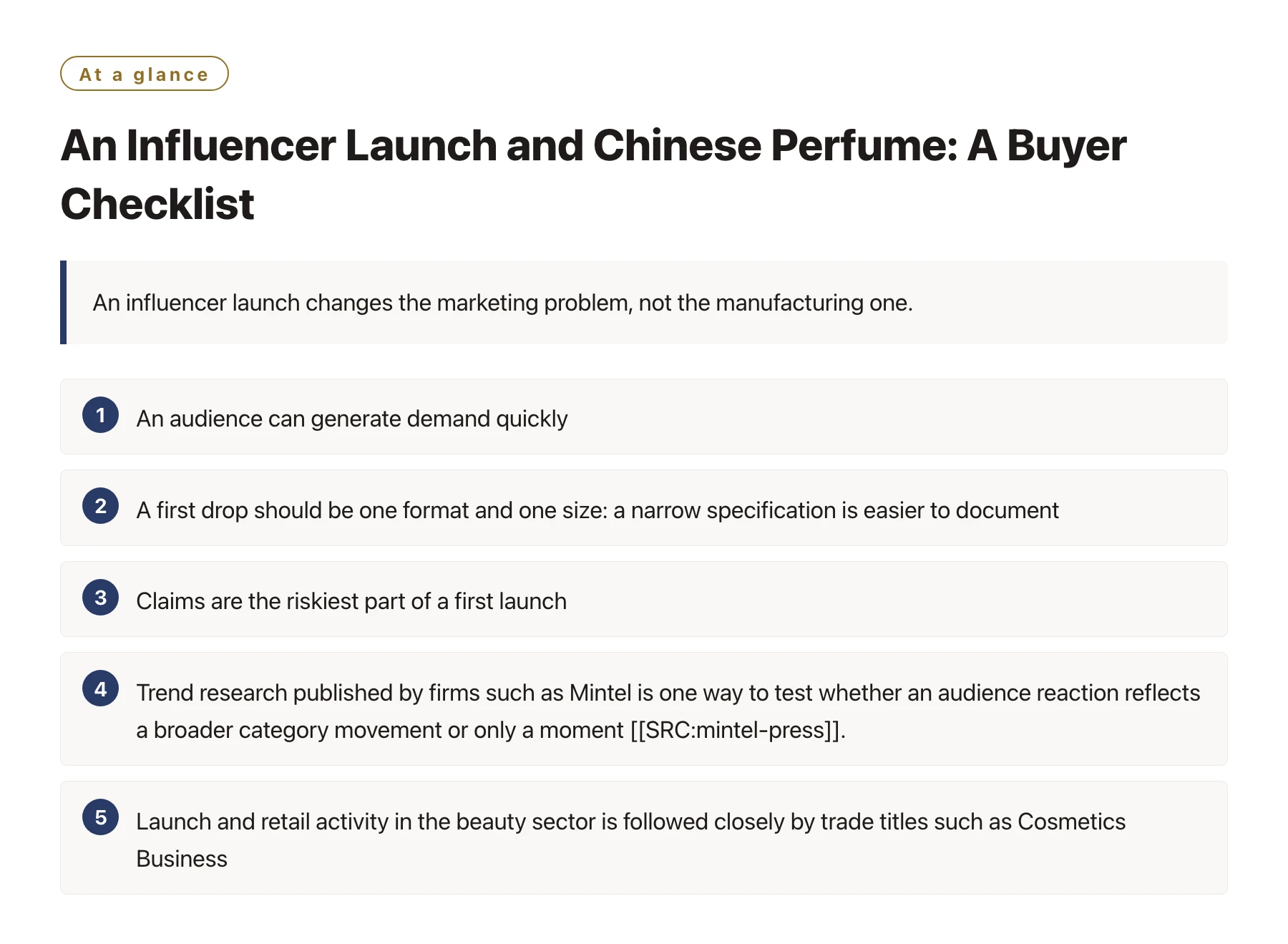
Key takeawaysAn audience can generate demand quickly, but it cannot shorten material lead times, testing or freight, so the sourcing calendar has to be built before the announcement. · A first drop should be one format and one size: a narrow specification is easier to document, easier to pack and far easier to replace if a batch has to be remade. · Claims are the riskiest part of a first launch, because a statement made in a video is a statement the brand has to evidence afterwards. · Trend research published by firms such as Mintel is one way to test whether an audience reaction reflects a broader category movement or only a moment [1]. · Launch and retail activity in the beauty sector is followed closely by trade titles such as Cosmetics Business, which is useful context when setting expectations for a first drop [2]. · Regulatory expectations differ by market, and the European Commission's overview of cosmetics regulation is a useful reference for one of the largest regulated markets [3].
Influencer-led fragrance brands have a different starting shape from a traditional launch. The audience exists first, the product follows, and the first order is often small enough to be a test rather than a commitment. That shape creates both an advantage and a trap.
The advantage is that demand can be validated cheaply. The trap is that a small first order still carries the full weight of specification, documentation and quality control. This checklist is written for a creator or founder preparing that first order.
What the launch promises and what the order must confirm
| What the launch promises | What the supplier must confirm | Warning sign |
|---|---|---|
| A scent that matches the audience's taste | A defined direction and at least two evaluation rounds before approval | A scent chosen from a stock list without discussing the audience at all |
| Delivery in time for the announcement | Stage-by-stage lead times with the assumptions written down | A single delivery date with no stage breakdown |
| A product that can be described in specific terms | Documented material and testing evidence behind each claim | Claims discussed only in marketing language, never in specifications |
| Packaging worth photographing | A pack that has been costed together with the filling step | Decoration decided after the juice has been approved |
| A product that survives shipping and returns | Component durability, fill accuracy and spare units for replacements | No discussion of transit protection or replacement stock |
The third column is the useful one. Each warning sign points to a stage that has not been planned, and each of those stages becomes urgent the week the audience is waiting.
Why Chinese perfume production is a reasonable first base
The Chinese fragrance manufacturing sector is large, export-oriented and used to working with brands that have no factory of their own. That makes it a practical base for a first line, particularly when the brand needs development work rather than a finished stock product.
The relevant question is not whether Chinese perfumery can produce a good scent. It is whether the specific partner understands the market the product is being sold into. Understanding what the global market wants from Chinese perfume is a better screening criterion than a general capability claim, because it tests the partner's familiarity with the destination rather than its equipment list.
Two practical differences are worth planning for. First, development and production are usually quoted in stages, so a brand expecting one price for a finished product will need to ask for the structure. Second, communication happens across time zones and often in writing, which rewards brands that consolidate feedback instead of sending it in fragments.
The third difference is cultural rather than operational. Chinese perfumery draws on a material vocabulary that is genuinely distinctive, and a launch that leans on that vocabulary has a story attached. A launch that ignores it is competing on price and packaging alone.
A five-step buyer sequence for a first drop
- Step 1: Fix the format before the scentChoose one format and one size. Concentration, fill and container determine the process route, and narrowing them first makes every later quote comparable.
- Step 2: Write the brief as a documentInclude the audience, a described direction, the price band, the launch window and anything that must not appear in the formula.
- Step 3: Ask for the evidence behind each claimList the claims the launch will make, then ask which documents support each one. Claims that cannot be supported should be removed rather than softened.
- Step 4: Cost the pack and the juice togetherA pack chosen on appearance alone frequently costs more than the liquid. Ask for the two to be quoted as one product with the decoration steps named.
- Step 5: Order spare unitsA launch with an audience generates returns and replacements. Spare units cost less than a second production run and protect the customer experience in the first weeks.
Claims, evidence and the audience's trust
An influencer launch usually makes claims. Some are about performance, some about ingredients, and some about values. Each one narrows the specification, and the narrower the specification, the more the brand depends on the supplier's records.
The safe approach is to decide the claims before the brief, not after the product. A claim made in a video cannot be adjusted after shipping without damaging trust, so the evidence check belongs at the briefing stage. Where a claim depends on the safety assessment of fragrance materials, the assessment framework applied by the industry is a useful reference point [4].
It is also worth separating claims that are legal requirements from claims that are marketing choices. A required statement is documented as a matter of routine; a values claim is often a brand definition that has to be written down and enforced. The second kind is where a first launch most often overreaches.
Market rules matter here too. Requirements differ between destinations, and the European Commission's overview of how the cosmetics market is regulated is one reference for checking what a specific market expects [3].
Finally, keep the return path in mind while choosing the pack. A product that is difficult to ship is difficult to replace, and an audience is quick to notice when a replacement takes three weeks.
Storytelling, scent culture and the museum visit
A fragrance brand without a story is a commodity with a label. The most durable stories come from the material and cultural side of scent, and visiting the museum of scent in Guangzhou is one way for a product team to see how a scent narrative is built for visitors rather than for buyers.
It also has a practical use. A museum visit forces a team to describe scent in words, which is exactly what a briefing document requires. Teams that have practised that description tend to write better briefs and waste fewer sampling rounds.
The manufacturing side of the story should be equally concrete. Brands describing private label fragrance production as their route are usually working from an existing direction rather than commissioning development, which suits a first drop with a short lead time. Development work suits a brand that wants a scent nobody else has.
Choose the route that matches the promise being made to the audience. A launch built on exclusivity needs development; a launch built on value and speed can be served well by a private label approach. What it cannot do is promise exclusivity while ordering a stock direction.
Treat the first drop as a specification exercise with a marketing deadline attached. Decide the format, the claims and the pack before the announcement, and the audience will never see the parts of the project that were difficult.
Sources
- Mintel Press Centre —— Mintel's press releases on consumer and beauty market research, including fragrance and personal care trend reporting.
- Cosmetics Business —— A trade publication covering the beauty and cosmetics industry, including fragrance launches and regulatory developments.
- European Commission: Cosmetics in the EU —— The European Commission's overview of EU cosmetics rules, including the responsible person, product information file and safety report requirements.
- IFRA: Safe Use and Fragrance Science —— IFRA's explanation of how fragrance materials are scientifically assessed for safe use and how those conclusions are applied by the industry.
Frequently asked questions
How far in advance should an influencer fragrance launch be planned?
Plan from the sourcing calendar rather than from the announcement date. Development, sampling, testing and freight all sit before the drop, and the announcement should be timed to the point where the production schedule is already fixed.
Can a small first order be produced in China?
Often yes, but the floor is set by the concentrate batch size, the filling line format or the component minimums. Ask which of the three sets the minimum, because that is the constraint to negotiate if the first order is small.
What claims should a first fragrance launch avoid?
Any claim that cannot be tied to a document. Performance claims, ingredient claims and values claims all require evidence, and a values claim that has not been defined internally is the hardest to defend because nobody can say exactly what it means.
Should the packaging be designed before or after the scent is approved?
At the same time, or earlier. Component availability and decoration lead times sit on the critical path, and a pack presented to the audience is part of the product promise. Leaving it until after scent approval is a common cause of a missed drop date.
How many spare units should be ordered?
Enough to cover replacements and returns during the first selling period, based on the return rate the brand expects. Spare units are cheaper than a second run and they protect the launch, but they should be decided before filling rather than requested afterwards.