
Checking a Miner's Power Supply and Payout
A power supply does not appear in the payout formula, but it decides whether the formula ever runs at full rate. At 138 TH/s, current conditions produce 6.191e-05 BTC a day, worth $5.24 at $84,692 per BTC, or $5.03 after the listed 4% on the block-reward component. A supply that cannot hold its voltage under load turns that figure into a ceiling rather than a result.

Key takeaways
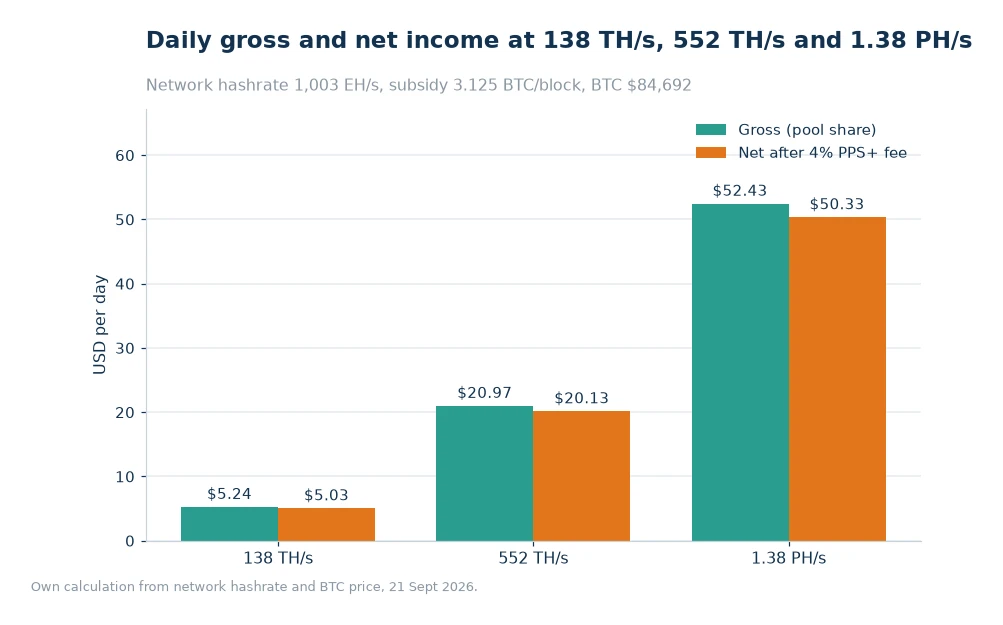
- At 138 TH/s, daily output is 6.191e-05 BTC, or $5.24 gross and $5.03 net of the listed 4% on the block-reward component.
- At 1.38 PH/s the same inputs give 0.00061908 BTC a day, $52.43 gross and $50.33 net.
- A supply running near its rated limit is a derating risk, and derating shows up as a lower reported hashrate.
- PPS+ pays hourly against current difficulty; PPLNS pays after 6 confirmations across the last 5 difficulty rounds.
The power supply is a payout component
Miners tend to price the machine and forget the supply. That is a mistake, because the supply converts the wall current into the low-voltage rail the boards need, and any inefficiency or voltage sag is paid for twice: once at the meter and again in lost hashrate. A unit running near its limit may work in a cool room and fail in a warm one, which makes the problem look intermittent when it is really a capacity issue.
The practical checks are simple. Confirm the supply's continuous rating, not its peak rating. Confirm that the connectors and cables are rated for the current the machine draws. Confirm that the supply has headroom above the machine's rated draw, so a hot afternoon or a transient does not push it into protection. Those three checks cost an hour and can prevent a week of reduced output.
What the formula assumes about power
The daily payout formula assumes the machine is hashing at its rated speed. It does not know whether the supply is adequate, whether the room is cool or whether a board has dropped out. At 1,003 EH/s and 450 BTC a day, 138 TH/s produces 6.191e-05 BTC, but only if the machine submits shares at that rate for the full day.
The ViaBTC Bitcoin Mining account reports the hashrate that actually arrived, so a supply problem shows up as a gap between the reported figure and the nameplate. PPS+ settles hourly against current difficulty, which makes the gap visible quickly. PPLNS settles after 6 confirmations across the last 5 difficulty rounds, which can spread a short outage across a longer settlement window.
Three loads on one supply
The rows below are one machine, four machines and ten machines. The net column applies the listed 4% to the block-reward component and excludes power, which is the cost the supply draws from the wall. The table is a revenue ladder; the supply has to be sized for the load behind it.
| Hashrate | BTC per day | Gross USD per day | Net USD per day |
|---|---|---|---|
| 138 TH/s | 0.00006191 | $5.24 | $5.03 |
| 552 TH/s | 0.00024766 | $20.97 | $20.13 |
| 1.38 PH/s | 0.00061908 | $52.43 | $50.33 |
The middle row is four times the first, and the top row is ten times the first. At the single-machine level, a month of net output is about $150.90 before power. If the supply is running at 90% of its rating, that is not a comfortable margin for a warm room, and the risk is a shutdown that costs more than a larger supply would have cost at the start.
Connectors, ripple and headroom
Connectors are the most common weak point in a rebuilt rig. A connector rated below the current it carries will heat up, and heat raises resistance, which raises heat further. The result can be a melted plug or a board that resets under load. Use the connector count and rating the machine specifies, and inspect the plugs for discoloration whenever the rig is moved or serviced.
Ripple and voltage stability are harder to check without a meter, but the symptom is familiar: the machine works at low load and resets when the boards ramp up. A supply with adequate headroom and good regulation avoids that pattern. If a supply has to be pushed to its limit to run the machine, the right answer is a larger unit, not a higher fan curve.
When to replace rather than repair
A failed fan is a repair. A supply that trips under load, shows discolored connectors or cannot hold voltage is a replacement. The distinction matters because a marginal supply can appear to work for weeks, then fail during a heatwave when the output is most valuable. Replacement is cheaper than a lost board and easier to plan than an emergency order.
The next difficulty estimate is minus 2.12%, which would raise output per terahash slightly if it holds. That is a small revenue change and no reason to postpone a supply replacement. The cost of an unreliable supply is measured in downtime, and downtime is not offset by a difficulty adjustment. Fix the hardware first, then update the payout estimate.
Worked example
Take 138 TH/s and run the chart arithmetic with the inputs read on 21 Sept 2026.
- Daily BTC per TH/s is 450 divided by 1,003,000,000, which equals 4.4865e-07.
- Multiply by 138: 4.4865e-07 times 138 equals 6.1914e-05 BTC, shown as 6.191e-05.
- Multiply by the BTC price: 6.1914e-05 times $84,692 equals $5.24 gross.
- Apply the listed 4% to the block-reward component: 4% of $5.24 is $0.21, leaving $5.03 net.
- Multiply by four for 552 TH/s: 0.00024766 BTC, $20.97 gross and $20.13 net.
- Multiply by ten for 1.38 PH/s: 0.00061908 BTC, $52.43 gross and $50.33 net.
- Thirty days at 138 TH/s nets about $150.90 before power, which is the revenue a supply failure interrupts.
Check the supply, then the estimate
A Profit Calculator will tell you what the hashrate should earn at current difficulty. The supply tells you whether the machine can deliver that hashrate for a full day. Compare the two, and treat a persistent shortfall as a hardware question before adjusting the estimate.
Write the nameplate hashrate, the supply's continuous rating and the machine's rated draw on one line. If the rating is close to the draw, replace the supply before the next hot week. The payout formula is reliable; the hardware behind it has to be reliable too.
Frequently asked questions
How much headroom should a miner power supply have?
Enough that the machine's rated draw is comfortably below the supply's continuous rating, with room for a warm room and transient load. A supply run at its limit is a derating and shutdown risk.
Does a weak supply reduce the payout or stop it?
It can do both. A marginal supply may cause resets or derating, which lowers the reported hashrate and the daily BTC, and a failure stops output until the unit is replaced.
Is a power supply problem covered by the pool fee?
No. The listed 4% on the block-reward component and the listed 2% on transaction fees cover the pool service, not the hardware. The supply, the boards and the cooling are the operator's responsibility.
Size the supply for the worst day
Take the machine's rated draw, add the fans and the margin for a hot room, and compare it with the supply's continuous rating. At 138 TH/s the daily net is $5.03 before power, so an outage of a few days can cost more than the difference between an adequate supply and a marginal one. Buy the headroom once and the payout has a stable base.
Sources: the ViaBTC homepage for the pool setup and the fee schedule for the listed 4% and 2% rates. Network hashrate 1,003 EH/s, difficulty 132.76 T, subsidy 3.125 BTC per block, 450 BTC daily and BTC $84,692 were read 21 Sept 2026, published 22 Oct 2026[1]. Every dollar figure is arithmetic on those inputs and moves when they move.